


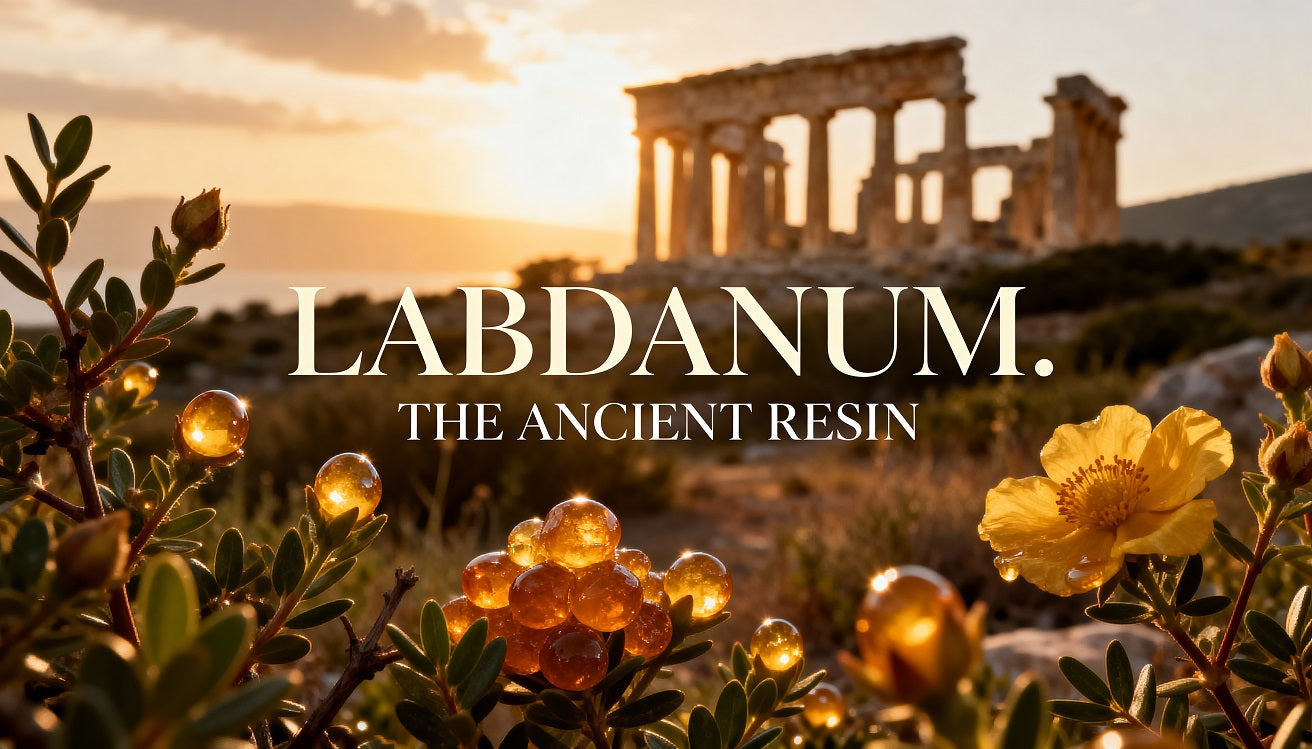
What Is Labdanum?
The Ancient Resin Behind Myth-Inspired Fragrances
Picture this: ancient shepherds in Crete noticed something unusual clinging to their goats' beards after the animals grazed on wild shrubs. That sticky, aromatic substance turned out to be one of perfumery's most precious ingredients, used for over 3,000 years in everything from sacred Egyptian rituals to today's luxury fragrances.
This remarkable resin, called labdanum, has a story as rich and complex as its scent. From the legendary tears of Osiris to the golden bottles of modern niche perfumery, labdanum connects us to an unbroken tradition of scent artistry that spans millennia.
At Argos Fragrances, we honor this ancient ingredient throughout our myth-inspired collection. In our signature Midas Touch Extrait de Parfum, labdanum provides the warm, golden heart that embodies King Midas's legendary power. Let us explore what makes this resin so extraordinary.
Understanding Labdanum: Nature's Golden Resin

Labdanum (pronounced LAB-da-num) is a sticky, aromatic resin that comes from Mediterranean rockrose shrubs. Two species produce this precious material: Cistus ladanifer in the western Mediterranean and Cistus creticus in the eastern regions, particularly Greece and Crete.
These hardy plants thrive in harsh conditions, rocky soil, intense heat, and minimal water. Labdanum is not decorative; it is a survival mechanism secreted from the leaves to protect against environmental stress. Nature created the defense system. Humans discovered perfumery gold.
From Goat Beards to Modern Extraction

The traditional harvesting method sounds almost mythical. Ancient shepherds would comb the sticky resin from the beards and fur of goats and sheep that brushed against cistus shrubs while grazing. This labor-intensive process reflected labdanum's immense value in the ancient world.
In 19th-century Crete, collectors used a specialized tool called a ladanisterion, a rake fitted with leather thongs, to sweep resin from the bushes. Some traditional harvesting methods still exist today, maintaining a living connection to ancient practices.
Modern extraction uses more efficient techniques. Leaves and twigs may be boiled to extract raw resin, or processed through solvent extraction to create labdanum absolute, the highly concentrated form preferred by fine perfumers. Steam distillation produces labdanum essential oil with a more refined aromatic profile.
The Scent of Labdanum: Warm, Complex, Unforgettable

So, what does labdanum actually smell like?
Its aroma is beautifully multifaceted. The dominant impression is warm and balsamic, similar to amber resin accords, with a natural honey-like sweetness that never feels cloying. Beneath that warmth are subtle leather nuances, soft smokiness, and woody depth.
Many detect dried fruit notes, plum or dates, along with a gentle musky warmth that feels almost skin-like. Labdanum evolves on the skin, opening with brighter woody facets before settling into its signature golden embrace.
Labdanum vs. Amber: What's the Difference?

Despite common confusion, labdanum and amber are not the same.
Amber in perfumery is a fantasy accord, created by blending ingredients rather than by extracting a single source. The classic amber structure combines labdanum, vanilla, and benzoin. Labdanum provides the resinous backbone, vanilla adds sweetness, and benzoin brings spicy warmth.
Think of labdanum as the essential foundation; without it, true amber simply does not exist.
Labdanum also serves as a sustainable alternative to ambergris; the rare substance historically sourced from sperm whales. With ethical and legal concerns surrounding ambergris, labdanum has become the preferred choice for warm, musky depth and excellent fixative power.
Ancient Mythology and Sacred History

Labdanum's story is inseparable from mythology and ritual.
Ancient Egyptians believed that labdanum was formed from the divine tears of Osiris, the god of the afterlife and rebirth. Pharaohs wore ceremonial false beards made from goat fur soaked in labdanum, symbolizing divine authority and spiritual legitimacy.
The resin was a key ingredient in Kyphi, the sacred incense burned in temples along the Nile for worship, healing, and mummification.
Greek and Roman civilizations prized labdanum above nearly all other aromatics. Herodotus wrote of its sweet scent emerging from the harshest landscapes. It was burned in temples, worn as perfume, and traded across Mediterranean routes.
By the 9th century, Arabian perfumers refined labdanum into sophisticated formulas, understanding what modern perfumers know today: its fixative properties give fragrances longevity and profound depth.
The Argos Connection
This mythological heritage makes labdanum a perfect fit for Argos Fragrances' philosophy of blending ancient legend with modern artistry. When you wear Midas Touch, you connect with pharaohs, Greek priests, and master perfumers across 3,000 years of scent history.
Why Modern Perfumers Love Labdanum

As a base note, labdanum anchors a fragrance alongside materials like patchouli and vetiver. It slows evaporation, enhances longevity (often 8–12+ hours), and smooths transitions between contrasting notes.
It prevents fragrances from feeling thin or fleeting and lends warmth, richness, and cohesion to complex compositions.
Where Labdanum Shines
Amber & Oriental fragrances – the cornerstone of warmth and sensuality
Chypre compositions – bridging bright citrus with earthy depth.
Leather fragrances – refined, elegant leather without harshness.
Woody-amber blends – pairing beautifully with cedarwood, sandalwood, patchouli, and vetiver.
Labdanum also complements citrus, florals, spices, and other resins, making it one of perfumery's most versatile materials.
Labdanum in Argos Fragrances
We incorporate labdanum into six fragrances across our myth-inspired collection, each telling a different legend.
Midas Touch: Where Labdanum Shines Brightest

Midas Touch Extrait de Parfum showcases labdanum at its most opulent. Inspired by the myth of King Midas, the fragrance captures both golden brilliance and tragic excess.
Labdanum's honeyed warmth mirrors the glow of Midas's legendary touch while grounding the composition with resinous depth and exceptional longevity.
Opening: bergamot, gurjum balsam, tuberose
Heart: labdanum, osmanthus, rose, leather
Base: labdanum, patchouli, nagarmota, benzoin, oud
Other Argos Fragrance Creations With Labdanum
Fire and Desire (Vulcan's Revenge) – smoky tension and heated depth
Neptune's Trident – ambered marine grounding with vetiver
Birth of Venus – luminous florals warmed by resinous glow
Charon's Vail – incense-like darkness with saffron
Fall of Phaeton – burning skies and divine turmoil
Choosing Your First Labdanum Fragrance
If you are new to labdanum, begin with amber-forward compositions blended with vanilla and benzoin. Sampling is key; labdanum evolves beautifully over 8–12 hours, revealing its full character with time.
Sustainability and Quality

Labdanum represents ethical luxury in modern perfumery. It is plant-based, renewable, and supports Mediterranean farming communities. Cistus shrubs require minimal water and no pesticides, thriving naturally in harsh environments.
At Argos Fragrances, we use responsibly sourced premium labdanum absolute and resin. Our fragrances are crafted without parabens, sulfates, phthalates, or synthetic dyes, only pure, artisanal luxury.
The Timeless Beauty of Labdanum
From ancient goat beards to modern extrait de parfum, labdanum remains one of perfumery's most treasured materials. It bridges mythology and modernity, ritual and refinement, fleeting moments, and lasting beauty.
To wear labdanum is to wear history, divine tears, sacred smoke, and golden warmth carried through time.
Discover Labdanum at Argos Fragrances
Experience this ancient resin in our myth-inspired collection. In Midas Touch Extrait de Parfum, labdanum embodies the legendary power of King Midas himself.
This is more than fragrance. It is wearable mythology.
Explore the collection at argosfragrances.com.



Leave a comment
This site is protected by hCaptcha and the hCaptcha Privacy Policy and Terms of Service apply.