


The Language of Flowers: How Mythology, Masterpieces, and Fine Fragrance Have Celebrated Beauty for Centuries
By Lucien Marlowe, Luxury Fragrance Editor | House of Argos
How Mythology, Masterpieces, and Fine Fragrance Have Celebrated Beauty for Centuries
Long before artists covered cathedral ceilings with masterpieces. Before marble temples rose above the hills of ancient Greece. Before perfume rested inside crystal bottles upon elegant vanities. There were flowers.
They appeared quietly, asking for nothing. They bloomed beside rivers that had never been named, across hills untouched by civilization, and beneath skies that belonged only to the rhythm of nature. They asked for no audience, sought no admiration, and yet somehow became one of humanity's earliest symbols of beauty.
Long before we learned to preserve beauty with paint, poetry, or perfume, we found it blooming beneath our feet.
Perhaps that is why flowers have remained with us for thousands of years. Every civilization has given them meaning. They crowned victorious athletes in ancient Greece. They honored the departed in sacred ceremonies. They celebrated weddings, welcomed children into the world, and marked the changing of the seasons. They became symbols of devotion, remembrance, hope, abundance, and love, not because anyone assigned those meanings, but because generations of people quietly recognized them within every blossom.
Flowers became humanity's first unspoken language. A single bloom could express gratitude more gracefully than a speech. A bouquet could celebrate joy without a single written word. Even today, centuries later, we instinctively understand the gesture. Beauty has always spoken most eloquently in silence.

How Artists First Understood the Language of Flowers
Artists understood this language long before museums preserved their work behind glass. Flowers became enduring symbols woven into the history of art itself. They softened royal portraits, transformed landscapes into living poetry, and offered painters a way to speak about beauty, innocence, abundance, and transformation without ever needing to explain themselves.
Few artists understood this language more profoundly than Sandro Botticelli. His paintings did more than portray flowers. They allowed them to breathe. In The Birth of Venus, blossoms drift across the sea as Venus emerges, symbolizing beauty arriving in the world with grace and quiet wonder. In Primavera, hundreds of carefully painted flowers transform an ordinary meadow into an eternal celebration of harmony, renewal, and nature's endless capacity to begin again. The flowers are not decoration. They are part of the story.
Perhaps that is why these masterpieces continue to resonate more than five centuries after they were painted. They remind us that beauty has never been something we simply observe. It is something we experience.
How Perfumery Learned to Preserve What Art Could Only Capture
The same truth has guided perfumery since its earliest beginnings. Long before fragrance became an expression of personal style, flowers were distilled into precious oils, infused into ceremonial rituals, and treasured as gifts worthy of royalty. Jasmine, rose, orange blossom, narcissus, lavender, and countless other botanicals traveled across continents, prized not only for their rarity but for the emotions they awakened.
To early perfumers, flowers represented something extraordinary. They transformed fleeting beauty into something lasting. A blossom may bloom for only a short season. Its fragrance could endure for generations.
That pursuit continues today. Every exceptional fragrance begins with a simple question: how do we preserve a feeling? Not merely the aroma of a flower, but the emotion it inspires. The optimism of standing in a garden just after sunrise. The quiet peace of sunlight filtering through trees. The anticipation carried by the first blossom of a new season. The elegance of a single flower resting upon a linen-covered table before an unforgettable evening begins.
Great perfumery has never attempted to imitate nature. It seeks to honor it.
This philosophy lies at the very heart of the House of Argos. Since its founding in 2014, the House of Argos has drawn inspiration from mythology, history, and timeless works of art to create Extrait de Parfums that celebrate storytelling as much as craftsmanship. Every composition begins with a legend, a masterpiece, or a moment that has endured across centuries before being reimagined through exceptional raw materials and modern perfumery.
Some celebrate beauty's first awakening. Others honor nature's quiet harmony. Others explore the extraordinary transformation that occurs when admiration deepens into fascination. Together, they reveal something flowers have always understood. Beauty is never still. It is born. It blossoms. It transforms. It becomes unforgettable.
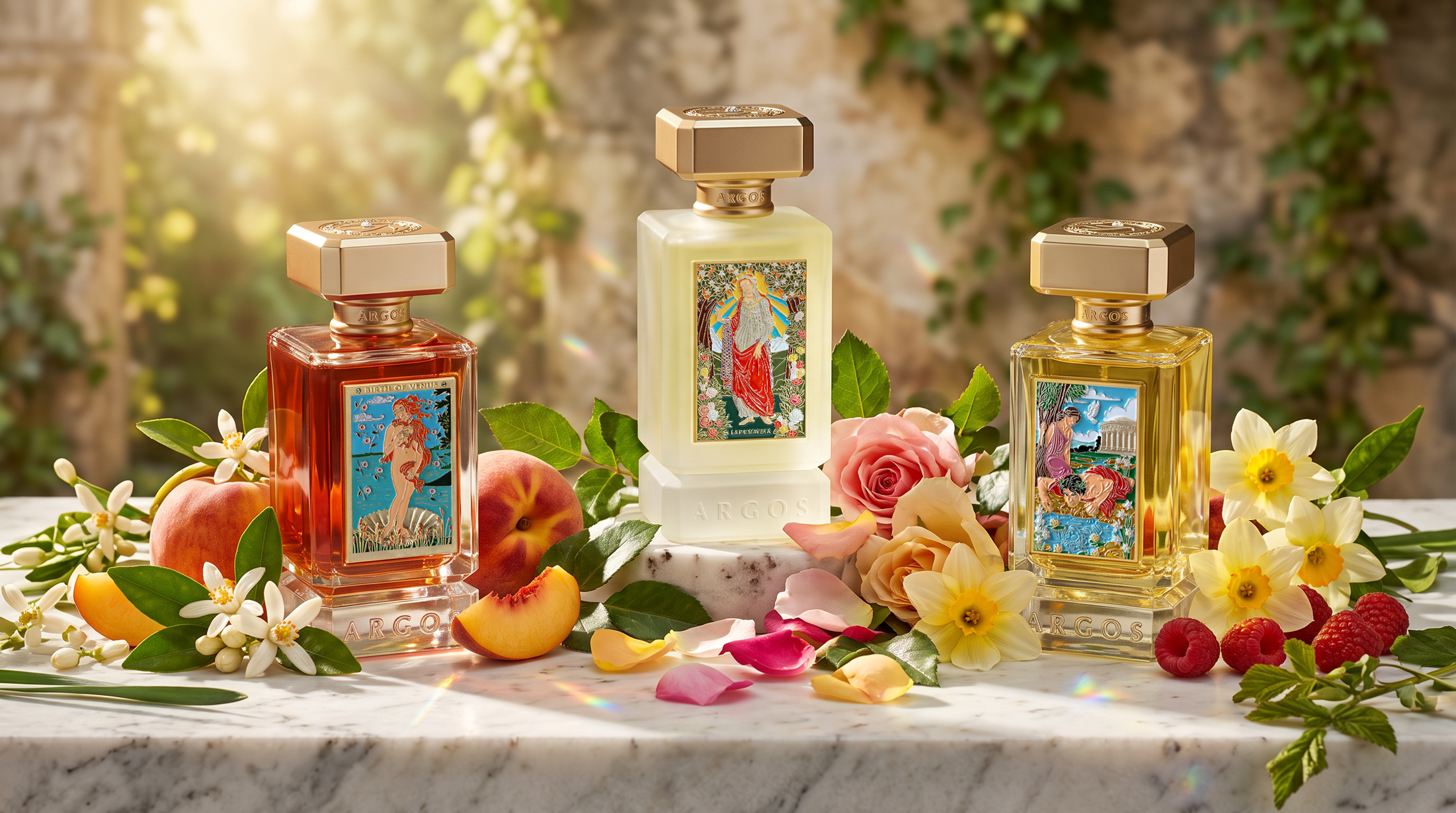
Few collections embody that timeless journey more beautifully than Birth of Venus, La Primavera, and Narcissus: Obsession in Bloom, three compositions inspired by masterpieces of art and enduring mythology, each capturing a different chapter in the story of beauty itself.
Before we explore the fragrances, however, we must first return to the stories that inspired them. Because every remarkable creation begins long before the first note touches the skin. It begins with a legend.
Where Beauty Is Born
Birth of Venus: The Moment the World Changed

There are moments in history that seem to exist beyond time. They continue to inspire long after the civilizations that first celebrated them have disappeared. Their stories are retold, their images reimagined, and their meaning rediscovered by every generation that encounters them.
The birth of Venus is one of those moments. According to classical mythology, Venus emerged from the sea not as a conqueror, nor as a ruler, but as beauty itself. Carried gently toward the shore upon a scallop shell, she arrived with grace rather than spectacle, reminding the ancient world that beauty possesses a remarkable kind of strength, one that transforms without force and captivates without demanding attention.
For centuries, artists sought to capture that moment. None more famously than Sandro Botticelli. Painted during the Italian Renaissance, The Birth of Venus remains one of the world's most recognizable masterpieces. Yet its enduring influence extends far beyond technical brilliance or artistic achievement. It continues to resonate because it captures something deeply human: the wonder of witnessing beauty for the very first time. Nothing feels hurried. Nothing feels excessive. The painting invites the viewer to pause, to appreciate beauty not as ornament, but as an experience.
This philosophy lives at the heart of Birth of Venus by the House of Argos. Rather than attempting to recreate Botticelli's painting, the fragrance captures its atmosphere, radiant, graceful, and quietly unforgettable. It celebrates the moment beauty first reveals itself, where freshness, elegance, and warmth exist in perfect harmony.
The opening feels luminous. Bright bergamot introduces sparkling freshness while juicy peach adds gentle sweetness without becoming overpowering. Orange blossom brings an unmistakable elegance, grapefruit contributes vibrant clarity, and lavender introduces a calming sophistication that immediately establishes balance. Like the first light dancing across the sea, the composition feels vibrant yet serene.
As the fragrance begins to bloom, it reveals its heart with remarkable artistry. Narcissus lends distinctive floral richness while jasmine sambac unfolds with luminous elegance. Rose adds timeless refinement, raspberry introduces subtle brightness, and an unexpected touch of chocolate creates warmth and intrigue, transforming the composition into something both comforting and irresistibly captivating. Every note feels intentional. Every transition feels effortless.
Then comes the foundation. Amber creates golden warmth. Vetiver provides elegant structure. Mysore sandalwood offers creamy refinement, while cashmere wood softens every edge with remarkable smoothness. Labdanum completes the composition, adding depth and richness that remain long after the brighter notes have gently faded.
The result is not merely a beautiful fragrance. It is a fragrance about beauty itself. Not beauty measured by perfection. Not beauty defined by fashion. But beauty understood as confidence, authenticity, and the quiet ability to leave the world a little brighter simply by existing within it.
The finest fragrances share this remarkable quality. They refuse to reveal everything at once. Instead, they invite discovery. With every passing hour, they evolve alongside the wearer, becoming less like perfume and more like memory itself. That is the difference between fragrance and fine perfumery. One is experienced. The other is remembered.
Fragrance Notes: Bergamot, Peach, Orange Blossom, Grapefruit, Lavender / Narcissus, Jasmine Sambac, Rose, Raspberry, Chocolate / Amber, Vetiver, Mysore Sandalwood, Cashmere Wood, Labdanum
Where Beauty Blossoms
La Primavera: The Quiet Poetry of Renewal

There is a reason humanity has always returned to the garden. Long before cities reached toward the sky and civilizations transformed stone into monuments, people understood that nature possessed its own extraordinary artistry. Seasons came and went. Trees shed their leaves only to bloom again. Flowers appeared where winter had once seemed endless, reminding us that beauty is never permanent and yet, somehow, it always returns.
Renewal has always been one of life's greatest luxuries. Not because it promises that nothing will change. But because it reminds us that every ending quietly makes room for another beginning.
Few works of art celebrate that truth more beautifully than Sandro Botticelli's Primavera. Painted during the height of the Italian Renaissance, the masterpiece is often admired for its extraordinary detail. Hundreds of botanically accurate flowers bloom across the meadow, each carefully placed to create an atmosphere that feels suspended somewhere between mythology and dream. Venus stands peacefully at the heart of the composition, while the Three Graces dance in effortless harmony. Yet Primavera is more than a celebration of nature. It is a meditation on balance. Every figure, every blossom, and every movement exists in quiet conversation with the next. Nothing competes for attention. Beauty is discovered not through excess, but through harmony.
That philosophy has always belonged to the finest expressions of luxury. The most memorable experiences rarely overwhelm the senses. Instead, they unfold naturally, inviting us to slow down long enough to appreciate what has always been there.
That spirit lives beautifully within La Primavera. Inspired by Botticelli's masterpiece, the fragrance captures the optimism and quiet elegance found in nature's endless rhythm of renewal. Rather than recreating the scent of a single flower or garden, it evokes something more profound: the feeling of possibility that accompanies every new beginning.
The composition opens with remarkable clarity. Bright bergamot introduces radiant freshness, while lemon adds vibrant energy and green leaf captures the crisp vitality of flourishing foliage. Together, they create an opening that feels luminous, clean, and effortlessly uplifting, like sunlight filtering through a garden at the first golden hour of the day.
As the fragrance unfolds, its floral heart emerges with graceful restraint. Rose contributes timeless elegance, while heliotrope introduces a soft, velvety warmth that gently embraces the composition without ever overwhelming it. The transition feels seamless, allowing every note the space to breathe and reveal its own quiet beauty.
The foundation is equally refined. Soft musk lends intimacy, vanilla provides gentle comfort, and vetiver offers subtle earthiness that anchors the fragrance with remarkable balance. Together, they create a finish that feels polished, serene, and enduring, a reminder that the most elegant fragrances rarely seek attention, yet remain unforgettable all the same.
There is a quiet confidence within La Primavera that feels deeply reassuring. It celebrates growth without urgency. Beauty without excess. Luxury without display. Like every garden, it continues to evolve. Like every meaningful story, it reveals new layers with time. And like every unforgettable bloom, it reminds us that the most extraordinary forms of beauty are often the ones that unfold quietly, one moment at a time.
Fragrance Notes: Bergamot, Lemon, Green Leaf / Rose, Heliotrope / Musk, Vanilla, Vetiver
Where Beauty Becomes Unforgettable
Narcissus: Obsession in Bloom

Some stories endure because they reveal uncomfortable truths. Not about gods. Not about heroes. But about ourselves.
Few figures in Greek mythology have been more widely misunderstood than Narcissus. His name has become synonymous with vanity, often reduced to the image of a young man hopelessly captivated by his own reflection. Yet mythology rarely survives for thousands of years because of simple lessons. The stories that endure continue to invite interpretation, each generation discovering something the last may have overlooked.
Perhaps the legend of Narcissus has never truly been about vanity at all. Perhaps it has always been about the search for identity. In Ovid's Metamorphoses, Narcissus pauses beside a still pool of water and becomes transfixed by the image before him. Unable to understand that he is looking at his own reflection, he reaches toward a beauty that forever remains just beyond his grasp. Beneath its surface lies a quieter truth: every person spends a lifetime searching for something. Purpose. Belonging. Understanding. The desire to become the fullest expression of who they were created to be. That journey requires reflection. Without reflection, there can be no growth. Without growth, there can be no transformation.
That philosophy lies at the heart of Narcissus: Obsession in Bloom. Rather than retelling the legend through caution alone, the fragrance reimagines it as a celebration of transformation, capturing the moment when admiration evolves into artistry, when curiosity deepens into appreciation, and when beauty reveals itself not as perfection, but as continual discovery.
The composition opens with immediate intrigue. Juicy raspberry introduces vibrant sweetness while aromatic tarragon adds unexpected freshness and green complexity. Clove buds bring warmth and subtle spice, creating an opening that feels both luminous and mysterious, a first impression that captures attention without revealing everything at once.
As the fragrance unfolds, its floral heart emerges with extraordinary elegance. Narcissus Absolute takes center stage, rich, radiant, and unmistakably refined. Tuberose lends creamy sophistication, geranium introduces vibrant freshness, and jasmine softens the composition with timeless floral beauty. Together they create remarkable depth, allowing every ingredient to shine while remaining beautifully balanced within the whole.
Then comes the transformation. Vanilla introduces warmth that feels smooth rather than sweet. Ylang ylang adds a luminous floral richness. Musk creates an intimate softness that settles naturally against the skin. Finally, Mysore sandalwood provides the quiet foundation upon which the entire composition rests, bringing exceptional refinement and lasting elegance to the fragrance's final chapter.
Nothing feels excessive. Nothing feels predictable. Every stage invites another discovery. Like standing before a great painting, each return reveals details that somehow escaped notice before. That is the hallmark of exceptional craftsmanship. It rewards attention.
Perhaps that is why Narcissus: Obsession in Bloom feels so profoundly modern despite drawing inspiration from one of antiquity's oldest legends. Its beauty is not static. It lives. It changes. It grows alongside the person who wears it.
The flower that bears Narcissus' name returns each year with remarkable quietness, blooming without announcement before gently yielding to another season. Yet its symbolism has endured for centuries because it reminds us of something beautifully simple. Transformation is never a single moment. It is a lifelong process. Every experience shapes us. Every lesson leaves its mark. Every season reveals another version of who we are becoming. The most unforgettable fragrance does the very same. It does not simply accompany the wearer. It becomes part of their story.
Fragrance Notes: Raspberry, Tarragon, Clove Buds / Narcissus Absolute, Tuberose, Geranium, Jasmine / Vanilla, Ylang Ylang, Musk, Mysore Sandalwood
The Lasting Bloom: Why Beauty Endures

Every flower eventually reaches the end of its season. Petals surrender to the wind. Gardens change with the passing months. Even the most extraordinary bloom exists for only a fleeting moment before nature quietly begins its work again. Yet beauty has never been measured by permanence. It has always been measured by the impression it leaves behind.
Perhaps that is why humanity has spent thousands of years searching for ways to preserve it. Artists captured flowers with brush and canvas so their brilliance could outlive the seasons that inspired them. Poets transformed blossoms into verses that could be recited long after the gardens themselves had disappeared. Mythmakers wove flowers into legends, ensuring their symbolism would continue to bloom in the hearts of future generations.
Perfumers chose another path. Rather than preserving how flowers looked, they sought to preserve how they made us feel. A single bloom may last only days. Its fragrance can remain in memory for decades. That pursuit has always been at the heart of fine perfumery. Not simply recreating nature. Honoring it.
Every remarkable fragrance begins with something fleeting, a blossom that opens for only a brief season, a citrus grove warmed by the morning sun, the delicate petals of jasmine unfolding beneath the evening sky. Through craftsmanship, patience, and artistry, these moments are transformed into compositions that continue to evolve long after the flowers themselves have faded. To understand how ancient myths inspire the Argos collection, and how the note structure of each composition is crafted, is to understand why these fragrances outlast the moment they are first worn.
That is what makes perfume unlike any other art form. A painting is admired. A sculpture is observed. Music fills a room. Fragrance becomes part of the person who wears it. It moves through celebrations. It lingers in embraces. It quietly accompanies life's most meaningful chapters until memory can no longer separate the scent from the moment itself.
The journey through Birth of Venus, La Primavera, and Narcissus: Obsession in Bloom reminds us that beauty has never been a destination. It is a continual unfolding.
Birth of Venus celebrates the wonder of first impressions, the quiet moment when beauty enters the world with grace and possibility. La Primavera reminds us that beauty flourishes through harmony, renewal, and the countless small moments that shape who we become. Narcissus: Obsession in Bloom reveals that true transformation is not found in admiration alone, but in the lifelong journey of reflection, growth, and authenticity.
Together, these stories reveal a truth that artists, philosophers, and perfumers have understood across centuries. Beauty is never static. It is always becoming.
Since 2014, the House of Argos has carried that philosophy into every Extrait de Parfum it creates. Inspired by mythology, timeless works of art, and exceptional craftsmanship, each fragrance is designed not merely to be worn, but to become part of the stories we tell without words.
Long after flowers have faded. Long after masterpieces have been admired. Long after legends have been retold. Fragrance continues the story. It carries beauty forward. It transforms fleeting moments into lasting memories. It reminds us that while every bloom is temporary, the emotions it inspires can endure for generations.
Perhaps that has always been the true language of flowers. Not spoken through petals. Not preserved by paint. But carried quietly, beautifully, and timelessly through fragrance.
At the House of Argos, every Extrait de Parfum begins with a legend. Discover the full collection and find the fragrance that tells your story. If you want to experience Birth of Venus, La Primavera, and Narcissus: Obsession in Bloom before choosing, the Argos sample pack lets you wear each composition on your own skin first. The story it tells next is yours.
Written by Lucien Marlowe, Luxury Fragrance Editor, The House of Argos Journal
"Exploring the timeless intersection of mythology, fine art, and modern perfumery."
Frequently Asked Questions
What is the language of flowers in perfumery?
The language of flowers in perfumery refers to the centuries-old tradition of using floral ingredients to communicate emotion, meaning, and identity through scent. Just as flowers have carried symbolic meaning across civilizations, from ancient Greek ceremonies to Renaissance masterpieces, the finest floral fragrances preserve those emotions in wearable form. A great floral Extrait de Parfum does not simply smell like flowers. It translates how flowers make us feel into a composition that evolves on the skin over hours.
What does Birth of Venus by Argos Fragrances smell like?
Birth of Venus opens with bergamot, peach, orange blossom, grapefruit, and lavender creating a radiant and luminous first impression. The heart develops through narcissus, jasmine sambac, rose, raspberry, and a subtle chocolate note. The base settles into amber, vetiver, Mysore sandalwood, cashmere wood, and labdanum. The overall character is radiant, graceful, and quietly memorable, inspired by Botticelli's 1484 Renaissance masterpiece.
What is La Primavera by Argos Fragrances?
La Primavera is an Extrait de Parfum from the House of Argos inspired by Botticelli's painting of spring and the mythology of Venus and the Three Graces. It opens with bergamot, lemon, and green leaf, develops through a rose and heliotrope heart, and settles into musk, vanilla, and vetiver. The composition is built around renewal, harmony, and the quiet optimism of a new beginning.
What is the Narcissus note in Narcissus: Obsession in Bloom?
Narcissus Absolute is one of perfumery's most distinctive and rare white floral materials. It has a rich, slightly green, intensely floral character that is simultaneously fresh and intoxicating. Unlike jasmine or rose, narcissus has a faintly waxy, narcotic quality that makes compositions built around it feel genuinely distinctive. In Narcissus: Obsession in Bloom, it is balanced by tuberose, geranium, jasmine, vanilla, and Mysore sandalwood to create a fragrance that is captivating without becoming heavy.
How are Botticelli's paintings connected to Argos Fragrances?
Argos Fragrances was founded in 2014 by perfumer Christian Petrovich with the philosophy that every fragrance should begin with a specific work of art or mythological story. Birth of Venus draws from Botticelli's 1484 painting of Venus emerging from the sea. La Primavera draws from Botticelli's allegorical painting of spring. Both compositions translate the atmosphere and emotion of the paintings into scent rather than attempting to recreate them literally.
Which of the three is best for everyday wear?
All three work for everyday wear at different levels of intensity. La Primavera is the lightest and most versatile, with a fresh green and floral character that suits spring, summer, and warm autumn days particularly well. Birth of Venus carries slightly more warmth from its amber and sandalwood base and suits both daytime and evening wear year-round. Narcissus: Obsession in Bloom is the most intense of the three and rewards patient wear most in cooler temperatures and evening settings. You can test all three with the Argos sample pack.


Leave a comment
This site is protected by hCaptcha and the hCaptcha Privacy Policy and Terms of Service apply.