


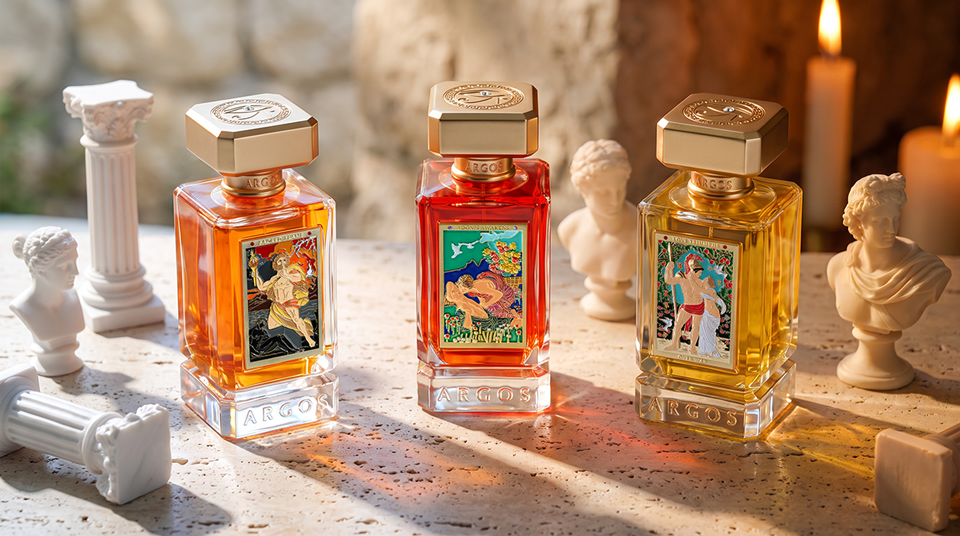
After the First Spray: Why the Drydown Changes Everything
By Camille Laurent, Fragrance and Culture Editor | The House of Argos Journal
The opening introduces a fragrance. Time reveals what it becomes.
There is a moment almost every fragrance lover knows. You spray something for the first time. Perhaps there is an immediate flash of citrus. A burst of spice. A flower appears. Something sweet catches your attention. Within seconds, you begin forming an opinion. But then something happens. An hour passes. You bring your wrist back toward your nose and the fragrance you thought you understood has changed. The citrus has softened. The florals feel warmer. The woods have moved forward. Something that seemed bright now feels sensual. Something that initially felt bold has moved closer to the skin. And suddenly, you smell the part you cannot stop returning to.
This is why a fragrance should rarely be judged by its first few minutes. The first spray is an introduction. The drydown is where the relationship begins.

Fragrance Was Designed to Move
Fragrance is not static. It develops. What you experience immediately after spraying is not necessarily what you will experience an hour later, and what remains several hours after that may feel different again. This evolution is often described through the familiar structure of top, heart, and base notes. Top notes tend to shape the initial impression. Heart notes emerge as that opening begins to soften. Base notes provide depth and become increasingly important as the fragrance settles.
But thinking of fragrance as three completely separate stages can make the experience sound more rigid than it actually is. Fragrance moves more naturally than that. Notes overlap. Transitions happen gradually. Some materials remain noticeable across multiple stages. Others seem to disappear before unexpectedly reappearing beside something warmer or deeper. The experience is less like three doors opening one after another and more like watching light change across the same room. The room remains. What you notice within it changes. To understand how top, heart, and base notes work together is to understand why patience with a fragrance always reveals more than the first thirty seconds ever could.
The Opening Gets Your Attention
There is a reason openings can be so captivating. They are immediate. Bright citrus. Fresh fruit. Aromatic herbs. Spices. Those first moments can provide energy and contrast before the deeper character of a fragrance begins to emerge. And because the opening is what we encounter first, it often receives disproportionate attention. It is the fragrance-counter moment. Spray. Smell. Decide.
But imagine judging a song by its opening seconds. Or a film by its first scene. The beginning matters. It establishes tone. It creates anticipation. But it is not the entire composition. A beautiful opening makes you notice. A beautiful evolution makes you stay.

Then the Fragrance Begins to Open Up
Give it time and the composition begins to reveal more of itself. The brightest opening materials soften. Floral, spicy, fruity, woody, or gourmand elements may become easier to recognize. Edges can become smoother. Contrasts begin making sense. This is often where a fragrance starts feeling less like something you sprayed and more like something you are wearing. That distinction matters. Because fragrance is not experienced only from a bottle or blotter. It becomes part of your presence. It moves with you. It warms against skin. It accompanies you through a room. And as time passes, the composition begins settling toward the part fragrance lovers often become particularly attached to: the drydown.
What Exactly Is the Drydown?
The drydown is the later stage of a fragrance's development, when the most volatile aspects of the opening have faded and longer-lasting elements become increasingly prominent. This is often where woods, amber effects, musks, vanilla, resins, patchouli, vetiver, tonka bean, and other deeper materials can become especially noticeable.
But the drydown is more than simply the base notes. It is the impression created by what remains. Traces of earlier parts of the composition may still be present. The heart may blend into the base. Something that initially seemed secondary can suddenly become one of the most compelling aspects of the fragrance. This is why the drydown can feel smoother, warmer, deeper, or more intimate than the opening. It has had time to settle. And in some compositions, that transformation is precisely the point.
Sacred Flame: When Fire Becomes an Ember
Sacred Flame Eau de Parfum

Few fragrances illustrate evolution as naturally as Sacred Flame. Inspired by Prometheus and the divine fire he gifted to humanity, Sacred Flame is a dynamic composition that reveals new facets as it develops on skin.
Its opening is appropriately vivid. Bergamot, grapefruit, peach, tangerine, ginger, pepper tree, and clove create brightness, spice, and energy. Then the composition moves through rose, tuberose, violet, jasmine, cinnamon bark, orris, and patchouli. Eventually, the fragrance settles into amber, vetiver, cashmere wood, Mysore sandalwood, benzoin, opoponax, tonka bean, and vanilla.
Look at that progression. Brightness. Spice. Florals. Woods. Resins. Warmth. The imagery almost writes itself. A flame begins brilliantly. Eventually, it burns lower. The brightness changes. But the heat remains. That is what makes Sacred Flame such an appropriate fragrance through which to understand the drydown. Its later character does not need to compete with the opening. It completes it. Some fragrances do not simply fade. They glow.
Fragrance Notes: Bergamot, Grapefruit, Peach, Tangerine, Ginger, Pepper Tree, Clove / Rose, Tuberose, Violet, Jasmine, Cinnamon Bark, Orris, Patchouli / Amber, Vetiver, Cashmere Wood, Mysore Sandalwood, Benzoin, Opoponax, Tonka Bean, Vanilla
Why Woods, Resins, and Amber Feel So Different Later
One of the pleasures of a drydown is discovering how the character of individual materials changes within the larger composition. Sandalwood can bring smoothness and warmth. Vetiver can contribute earthiness, dryness, freshness, or structure depending on how it is used. Patchouli can provide depth. Vanilla and tonka bean can create sweetness and softness. Benzoin and opoponax can introduce rich resinous warmth. Musks can contribute softness and a skin-like quality. Amber effects can make a composition feel glowing, enveloping, or warm.
None of these materials guarantees a particular result. Context matters. Proportion matters. What surrounds them matters. That is why reading a note pyramid can be useful, but it can never completely tell you what wearing the fragrance will feel like. Notes are information. Wearing is experience.
Adonis Awakens: When Attraction Moves Closer
Adonis Awakens Eau de Parfum

Not every compelling drydown needs to become dark or heavy. Adonis Awakens proves that beautifully. Inspired by John William Waterhouse's The Awakening of Adonis, the fragrance exists in a world of romance, desire, beauty, and renewal.
Its opening begins with bergamot, grapefruit, and pink peppercorn. The heart features Bulgarian rose, Sambac jasmine, vanilla, and raspberry. Then the fragrance settles into Mysore sandalwood, cashmere wood, and rose absolute.
The progression is particularly interesting because the floral identity does not simply disappear when the base arrives. Rose remains part of the story. But its surroundings change. Bright citrus gives way to woods. The fragrance feels increasingly grounded. The experience moves from introduction toward intimacy. And that is one of the most seductive possibilities of a drydown. A fragrance does not always need to become louder as it develops. Sometimes it becomes more compelling by drawing you closer. Attraction does not always announce itself from across the room. Sometimes it waits for someone to lean in.
Fragrance Notes: Bergamot, Grapefruit, Pink Peppercorn / Bulgarian Rose, Sambac Jasmine, Vanilla, Raspberry / Mysore Sandalwood, Cashmere Wood, Rose Absolute
Skin Changes the Experience
This is also why testing fragrance on skin matters. A paper blotter is useful. It can introduce you to a composition without interference from another fragrance. It can help you compare several scents. And it can give you an initial understanding of how a fragrance develops. But eventually, you need to wear it. Skin temperature, application, environment, and individual perception can all influence how you experience a fragrance over time. That does not mean a completely different perfume magically appears on every person. But the wearing experience is personal enough that the question that matters is not simply: does this smell good? It is: do I love what this becomes on me? Those are different questions. And the second one takes time to answer.
Love Triumphs Over War: When Softness Becomes the Lasting Impression
Love Triumphs Over War Eau de Parfum

There is something particularly fitting about a fragrance called Love Triumphs Over War becoming warmer and softer as it settles. Inspired by Peter Paul Rubens' depiction of Venus, Mars, and Cupid, Love Triumphs Over War explores the tension between tenderness and strength, love ultimately disarming conflict.
The opening arrives with bergamot, lemon, orange blossom, rose petals, and raspberry. The heart brings violet, cinnamon, geranium, gardenia, and iris. The base settles into amber, white musk, Mysore sandalwood, cashmere wood, patchouli, and vanilla.
The progression moves from brightness and florals toward something warmer and more enveloping. The composition does not need to shout to leave an impression. Instead, the later stages invite a different kind of attention. The fragrance remains. But differently. Sometimes the strongest impression is the one that stays after everything else has softened.
Fragrance Notes: Bergamot, Lemon, Orange Blossom, Rose Petals, Raspberry / Violet, Cinnamon, Geranium, Gardenia, Iris / Amber, White Musk, Mysore Sandalwood, Cashmere Wood, Patchouli, Vanilla
Do Not Confuse Softness with Disappearance
This is an important distinction. After wearing a fragrance for several hours, you may notice it less intensely than you did when you first sprayed it. That does not automatically mean everyone around you experiences it the same way. Our perception adjusts. Environmental conditions change. And naturally, fragrance does become less intense as materials evaporate over time. But a softer fragrance is not necessarily a fragrance that has disappeared. Sometimes the drydown is intentionally more intimate. It sits closer. It becomes less about making an entrance and more about what remains within someone's personal space. And depending on the fragrance, that may be exactly where its most beautiful character lives.

Why You Should Not Test Twelve Fragrances at Once
Fragrance discovery is exciting. Which means restraint can be difficult. You have twelve samples in front of you. Naturally, you want to smell all twelve. Immediately. But if your goal is to understand what each fragrance actually becomes, slowing down gives you far more information. Spray one. Wear it. Notice the opening. Then stop thinking about it for a while. Return to your wrist later. What changed? What remains? Which part surprised you? Do you like it more now than you did ten minutes after spraying? Would you want to smell this on yourself at the end of an evening? Those questions reveal much more than rapidly smelling one opening after another. Fragrance discovery should not feel like speed dating. Give the fragrance enough time to tell you who it is.
The Drydown May Be Where Memory Begins
Think about fragrances you have loved for years. Chances are, you do not remember only their first five minutes. You remember how they smelled on a coat. On someone's neck. At the end of dinner. In the car hours after getting ready. On a scarf the next morning. Those memories often belong to the later stages of fragrance. The scent is no longer announcing itself. It has simply become part of the moment. Perhaps that is one reason the drydown can feel so emotional. The opening belongs to anticipation. The drydown belongs to experience. And experience is where memory begins.
Discovery Takes Time

The best way to understand fragrance development is not simply to read about it. Wear it. The Argos Build Your Own Sample Pack lets you select 12 samples from across the House of Argos, with Eau de Parfum and Extrait de Parfum selections available.
But instead of approaching twelve samples as twelve fragrances to smell in one sitting, try approaching them as twelve experiences. Choose one. Spray it on skin. Notice the first five minutes. Return after an hour. Then again later. Ask yourself which stage you loved most. Perhaps the opening immediately wins you over. Perhaps the heart becomes the reason you keep smelling your wrist. Or perhaps the fragrance you were uncertain about initially transforms several hours later into the one you cannot stop thinking about. That is the value of sampling. It gives fragrance what it needs most. Time. Twelve fragrances. Twelve journeys. Stay long enough to discover where each one goes.
Stay for What Comes Next

We live in a culture of first impressions. The first photograph. The first few seconds. The immediate reaction. Fragrance asks for something different. Patience. The opening matters. So does the heart. But sometimes the most beautiful part arrives only after everything obvious has stepped aside. The woods become warmer. The resins deepen. The florals soften. The fragrance moves closer. And what began as something you simply smelled becomes something associated with your skin, your evening, your clothes, your memory.
So the next time you discover a new fragrance, do not ask only: do I like the first spray? Ask another question a few hours later. Do I love what it became? Because the opening may get your attention. But the drydown may be the reason you remember it.
Camille Laurent | Fragrance and Culture Editor | The House of Argos Journal
Wear something worth remembering. Be remembered. Undeniably Argos.
Frequently Asked Questions
What is a fragrance drydown?
The drydown is the later stage of a fragrance's development on skin, when the most volatile top note materials have faded and the deeper, longer-lasting elements of the composition become most prominent. This is typically where woods, resins, musks, vanilla, amber, and other base materials become especially noticeable. The drydown is often warmer, softer, and more intimate than the opening, and it is frequently the stage that creates the most lasting impression and the memories most closely associated with the fragrance.
Why does fragrance change after the first spray?
Fragrance is composed of materials with different volatility levels. The most volatile materials, typically the lighter citrus, aromatic, and fresh notes that make up the opening, evaporate first. As they fade, slower-evaporating materials in the heart and base become more prominent. Skin temperature, moisture, and individual body chemistry also interact with the composition over time, which is why the same fragrance can smell different an hour after application compared to the first few minutes.
Which Argos fragrance has the most impressive drydown?
Sacred Flame is the most dramatically transformative composition in the current Argos selection, moving from a vivid bright citrus and spice opening through an intricate floral heart before settling into a rich resinous base of benzoin, opoponax, Mysore sandalwood, tonka bean, and vanilla. Love Triumphs Over War offers a beautiful transition from bright florals to a warm amber, sandalwood, and vanilla base. Adonis Awakens demonstrates that a drydown can become more intimate and close to the skin without becoming heavy.
Should I judge a fragrance by its opening?
The opening is worth noticing, but it should not be the only stage you evaluate before making a decision. The opening establishes tone and creates anticipation, but the heart and drydown reveal the composition's full character. Many experienced fragrance buyers specifically reserve judgment until at least an hour after application, and some wait for the full drydown across four to six hours before deciding. The fragrance you were uncertain about in the first minutes sometimes becomes the one you cannot stop thinking about later.
How long does a fragrance drydown last?
The drydown, the stage at which base materials are most prominent, typically begins one to two hours after application and can last several hours beyond that depending on the concentration and the specific materials used. An Extrait de Parfum at high concentration generally produces a longer and richer drydown than a lighter Eau de Parfum of the same composition, which is one of the reasons Extrait concentrations are particularly valued by fragrance enthusiasts.
How do I properly test a fragrance drydown?
Apply the fragrance to clean skin on a pulse point such as the inner wrist or neck. Note your impression of the opening, then set aside for thirty to sixty minutes without smelling it repeatedly. Return to the application point and note what has changed. Repeat again after two to three hours. The fragrance you experience at this later stage is closer to what people around you will remember. The Argos Build Your Own Sample Pack is the ideal format for this approach, giving you time to wear each composition properly before moving to the next.


Leave a comment
This site is protected by hCaptcha and the hCaptcha Privacy Policy and Terms of Service apply.