


From Canvas to Composition: How Art and Mythology Become Fragrance
The House of Argos Journal
By Sebastian Vale | House of Argos Journal
How color, symbolism, emotion, and centuries-old stories can inspire an experience worn on the skin.
Before there is a fragrance, there is an idea. Sometimes it begins with a feeling. Sometimes with a place. Sometimes with a person who existed centuries ago. And sometimes, it begins with a work of art.
A painting does not have a scent. Mythology cannot be poured into a bottle. Color has no fragrance, and a story written thousands of years ago cannot literally tell us what something should smell like. And yet all of them can become part of perfume. That is one of the extraordinary qualities of fragrance. Perfumery allows something we see, remember, imagine, or feel to be interpreted through an entirely different sense.
A gold-covered canvas can suggest warmth and radiance. A mythological figure can evoke power, seduction, rebellion, or desire. A painting filled with movement can suggest a fragrance that seems to transform continually on skin. The translation is not literal. It is emotional. And within the House of Argos, the relationship between art, mythology, history, and fragrance becomes part of the language through which each creation invites us into another world.
So how does inspiration move from canvas to composition? It begins by looking beyond the notes.

Fragrance Is an Invisible Art
A painting occupies space. A sculpture has form. Music moves through time. Fragrance is different. You cannot see it once it leaves the bottle. Yet it can create an atmosphere almost immediately.
A fragrance can feel luminous without producing light. Dark without possessing color. Soft without having texture. Warm without producing heat. It can evoke velvet, polished wood, cold stone, ripe fruit, smoke, flowers, sunlight, or something entirely imagined. That is what makes fragrance such a fascinating medium for storytelling. The materials themselves may be tangible, but the experience they create often is not. Through contrast, harmony, tension, development, and atmosphere, fragrance can communicate something long before we consciously decide what it means.
And just like visual art, it does not always need to explain itself immediately. Sometimes its power lies in what it makes us feel before we understand why. Understanding how the top, heart, and base of a composition develop over time reveals why a fragrance can feel entirely different in its first hour from how it settles hours later, much like a painting that rewards closer looking.
When Color Becomes Scent
Imagine a painting dominated by gold. You cannot smell gold. But it might suggest warmth, radiance, opulence, light, perhaps something ancient or divine. Now imagine deep crimson. It could suggest passion, wine, roses, velvet, danger, or desire. White may feel celestial or pure. Black might evoke shadow, smoke, mystery, or night. None of those associations is absolute. And that is precisely what makes artistic interpretation compelling.
Within fragrance, a visual impression can become an emotional direction. Radiance might find an olfactory counterpart in sparkling citrus or luminous florals. Warmth might emerge through amber, vanilla, woods, resins, or spice. Darkness could be suggested through tobacco, patchouli, deep woods, or balsamic materials. The purpose is not to make a color itself smell. It is to make the fragrance feel the way the image looks. That distinction matters. Because fragrance inspired by art does not have to illustrate a painting. It can interpret its world.

Mythology Gives Fragrance a Character
If visual art can provide atmosphere, mythology can provide character. The gods and heroes of the ancient world were rarely one-dimensional. Athena embodied wisdom, strategy, courageous strength, justice, and the arts. Bacchus represented wine and celebration, but also liberation, ecstasy, theatre, and freedom from convention. Venus embodied beauty and love, while the mythology surrounding her explored passion, fertility, power, and desire. Prometheus represented fire but also foresight, rebellion, sacrifice, and the transmission of divine knowledge. Adonis became associated not only with beauty, but with desire, mortality, and renewal.
Those contradictions matter. Because compelling fragrance, like compelling mythology, does not have to exist in only one dimension. Something can be floral and powerful. Sweet and mysterious. Radiant and deep. Romantic and commanding. It is often the tension between opposites that gives a fragrance character. And mythology offers an extraordinary vocabulary for exploring those tensions. You can explore how ancient myths inspire every Argos composition to understand the philosophy behind each creation.

A Fragrance Does Not Have to Tell the Story Literally
This is where artistic perfumery becomes especially interesting. If a fragrance draws inspiration from Bacchus, it does not need to smell simply like wine. If Venus provides the artistic world, the composition does not need to be merely floral. If Athena is the subject, the fragrance obviously cannot literally smell like wisdom. That would reduce mythology to an ingredient list. Instead, fragrance gives us another way to enter the character of the story.
What might power feel like? What does indulgence suggest? Can beauty have weight? Can tenderness exist beside strength? Can something luminous also feel commanding? There are no objective answers. That is where interpretation begins.
Pallas Athene: Wisdom Made Visible
Pallas Athene Eau de Parfum

Gustav Klimt's 1898 Pallas Athene presents the goddess not as delicate, but commanding. Athena, the Greek goddess associated with wisdom, justice, courageous strength, and the arts, is portrayed armored and powerful. In Klimt's work she holds Nuda Veritas, or naked truth, while the imagery around her reinforces protection, strength, and artistic rebellion.
It creates a fascinating world for fragrance. How can something feel both beautiful and formidable?
Pallas Athene opens with bergamot, grapefruit, pink peppercorn, and red berry. The heart moves into peony, hyacinth, violet, and rose petals, creating a floral contrast to the brightness of the opening. At the base, iris, Mysore sandalwood, vetiver, patchouli, and vanilla give the composition depth and structure.
Radiance against depth. Floral beauty against strength. Romance against command. Within the fragrance, the artistic world of Pallas Athene finds an olfactory counterpart, one in which beauty does not diminish power. Beauty becomes more interesting when it has character behind it.
Fragrance Notes: Bergamot, Grapefruit, Pink Peppercorn, Red Berry / Peony, Hyacinth, Violet, Rose Petals / Iris, Mysore Sandalwood, Vetiver, Patchouli, Vanilla
Triumph of Bacchus: The Scent of Liberation
Triumph of Bacchus Eau de Parfum

Then the atmosphere changes completely. Athena represents wisdom and disciplined strength. Bacchus invites surrender. Wine. Celebration. Theatre. Ecstasy. Liberation. The Roman Bacchus is associated with wine and revelry: a figure who moves between order and chaos, the god of celebration, liberation, and outsiders.
That world naturally suggests a different kind of fragrance experience. Triumph of Bacchus Eau de Parfum opens with saffron, rhum notes, white peach, and green apple. The heart brings patchouli, jasmine, tonka bean, and vetiver. Then tobacco, amber, Mysore sandalwood, musk, and vanilla form a warm, enveloping base.
Spice. Fruit. Warmth. Richness. The composition becomes increasingly enveloping as it develops. Rather than claiming that every note directly represents a specific part of Bacchus's mythology, it is more compelling to experience the connection through atmosphere. The world is indulgent. Expressive. Unrestrained. A story of liberation becomes an atmosphere of indulgence.
Fragrance Notes: Saffron, Rhum Notes, White Peach, Green Apple / Patchouli, Jasmine, Tonka Bean, Vetiver / Tobacco, Amber, Mysore Sandalwood, Musk, Vanilla
Birth of Venus: When Beauty Becomes Atmosphere
Birth of Venus Eau de Parfum

Few works of Western art are as immediately recognizable as Sandro Botticelli's Birth of Venus. Venus emerges from the sea, luminous and fully formed. The image has endured for centuries because it evokes something larger than physical beauty alone. Movement. Grace. Mythology. Romance. The sense of something divine arriving in the human world.
But how does beauty become an atmosphere without becoming predictable? Birth of Venus opens with bergamot, peach, orange blossom, grapefruit, and lavender. The heart combines narcissus, jasmine sambac, rose, raspberry, and chocolate. Finally, amber, vetiver, Mysore sandalwood, cashmere wood, and labdanum create the warm foundation.
Freshness meets richness. Florals meet warmth. Light meets depth. Rather than reducing beauty to something simply pretty, the composition gives it dimension. And perhaps that is why the relationship between beauty and fragrance remains so fascinating. Beauty becomes memorable when it creates emotion.
Fragrance Notes: Bergamot, Peach, Orange Blossom, Grapefruit, Lavender / Narcissus, Jasmine Sambac, Rose, Raspberry, Chocolate / Amber, Vetiver, Mysore Sandalwood, Cashmere Wood, Labdanum
From Image to Emotion

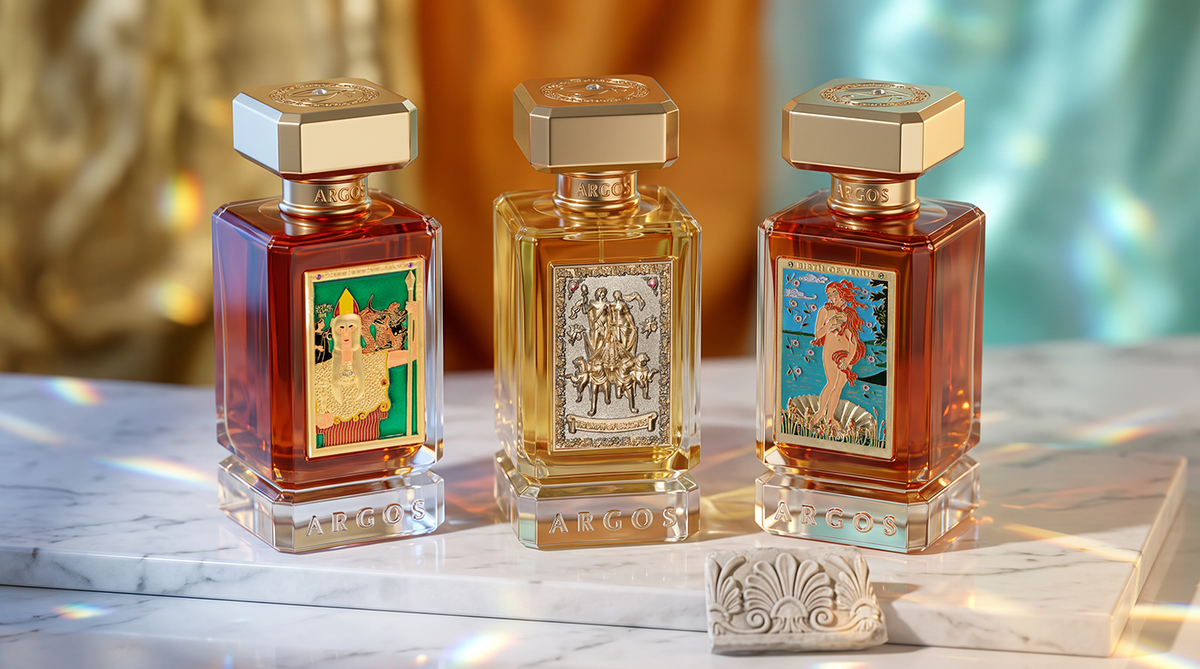
Place these three worlds beside one another and their differences become even clearer. Pallas Athene begins with wisdom, strength, and commanding beauty. Triumph of Bacchus enters indulgence, liberation, and celebration. Birth of Venus explores beauty, desire, and timeless allure.
The ingredients matter. But ingredients alone do not explain the entire experience. A note pyramid can tell you that a fragrance contains bergamot. It cannot tell you exactly what that bergamot will mean within the larger composition. It can tell you vanilla appears in a fragrance. It cannot explain whether that vanilla will feel sensual, comforting, rich, mysterious, or simply warm to you. That comes from context. From composition. From perception. And from the person wearing it. This is where storytelling gives fragrance another dimension.
The Bottle Becomes Part of the Story
Fragrance storytelling does not end with the liquid. Before someone smells a perfume, they often see it. They encounter its name. Its artwork. Its materials. Its ornamentation. Its presentation. All of those elements begin creating expectation before the first spray. That is particularly meaningful within the world of Argos, where classical imagery, fine art, mythology, and ornate presentation are integral to the visual identity of the House. The bottle becomes more than a container. It becomes a threshold. You see the world first. Then you smell it. Finally, you wear it.
And Then the Story Changes
This may be the most beautiful part. Once a fragrance leaves the bottle, its original inspiration is no longer the only story that matters. You become part of it. Pallas Athene may begin with Athena and Klimt. But perhaps you wear it on an evening when you feel especially powerful. Triumph of Bacchus may begin in a world of liberation and celebration. But perhaps it becomes the fragrance you forever associate with one particular night. Birth of Venus may originate in an artistic world of divine beauty. But years from now, perhaps one spray will return you to a city, a person, or a period of your life.
The original inspiration remains. But your experience joins it. The inspiration belongs to the artist. The memory belongs to the wearer. That is one of fragrance's most extraordinary qualities. You do not merely observe it. You carry it with you.
Why Storytelling Matters in Perfumery
There are thousands of fragrances in the world. Many smell beautiful. But fragrance lovers often search for something beyond pleasantness: character, meaning, discovery, something that feels worthy of returning to. Storytelling can give fragrance another dimension. It offers a lens through which the composition may be experienced. Perhaps you recognize the artistic reference immediately. Perhaps the mythology sends you searching for the original story. Perhaps you know nothing about the inspiration and simply fall in love with what is on your skin. All are valid. Because a story should never dictate what you must feel. It should give you somewhere to begin.
Do Not Just Discover a Fragrance. Discover a World.

Reading the story behind a fragrance can tell you where it began. A note pyramid can tell you what is inside. But neither can tell you exactly what will happen when the fragrance meets your skin, your memories, and your life. That part has to be experienced. The Argos Sample Pack allows you to create a selection of 12 fragrances from across the House, including Eau de Parfum and Extrait de Parfum options.
Approach discovery almost like visiting a gallery. Do not choose only what you already know. Choose a story that fascinates you. Choose one that feels completely unlike you. Choose something because of the artwork. Something because of the mythology. Something because of one note you cannot stop thinking about. Then wear them. Give them time. Notice which world you keep returning to. Because sometimes the fragrance that becomes yours is not the one you expected to choose. Twelve fragrances. Twelve stories. Which one becomes yours?
Wear the Story

Great art survives because it continues to make people feel something long after the moment in which it was created. A myth told thousands of years ago can still speak to desire, power, and human nature. A Renaissance painting can still shape how we think about beauty. A goddess painted in Vienna more than a century ago can still appear startlingly powerful.
Fragrance gives those worlds another way to live. Not as replicas. Not as history lessons. But as interpretations. Something once painted can become an atmosphere. Something once written can become an emotion. Something once imagined can become something worn on skin. And once you wear it, the story changes again. It encounters your life. Your experiences. Your memories. Your presence.
Perhaps that is the real journey from canvas to composition. It does not truly end when the fragrance enters the bottle. It ends when the story becomes part of yours.
Explore the full House of Argos collection and find the world that belongs to you.
Sebastian Vale | House of Argos Journal
Wear something worth remembering. Be remembered. Undeniably Argos.
Frequently Asked Questions
How does art inspire fragrance at the House of Argos?
Every Argos composition begins with a specific work of art or mythological story. Rather than translating a painting or legend literally into ingredients, the perfumer asks what the emotional world of that artwork feels like: its atmosphere, tensions, and character. A Klimt painting dominated by gold and armor might suggest warmth, commanding beauty, and strength, which become the emotional direction for the fragrance rather than a recipe of ingredients. The art provides the world. The fragrance inhabits it.
What painting inspired Pallas Athene by Argos Fragrances?
Pallas Athene is inspired by Gustav Klimt's 1898 portrait of Athena, the Greek goddess of wisdom, strategy, and courageous strength. Klimt portrays the goddess armored and commanding, holding Nuda Veritas, or naked truth, with imagery reinforcing protection, artistic rebellion, and power. The fragrance responds to this world through a composition that balances radiant citrus and floral beauty with the depth and structure of iris, Mysore sandalwood, vetiver, and patchouli.
What is Triumph of Bacchus Eau de Parfum inspired by?
Triumph of Bacchus draws from the Roman god of wine, celebration, liberation, and ecstasy. Bacchus represents freedom from convention and the permission to experience life with full presence. The Triumph of Bacchus Eau de Parfum captures that world through saffron, rhum notes, white peach, and green apple in the opening, building toward tobacco, amber, Mysore sandalwood, and vanilla at the base. The composition is designed to become more enveloping and indulgent as it develops.
What painting inspired Birth of Venus by Argos Fragrances?
Birth of Venus draws from Sandro Botticelli's iconic 1484 Renaissance masterpiece, one of the most recognized paintings in Western art history. The painting depicts Venus emerging from the sea fully formed, evoking grace, movement, divine beauty, and the sense of something extraordinary arriving in the world. The fragrance responds to this atmosphere rather than depicting it literally, opening with bergamot, peach, and orange blossom and settling into a warm base of amber, Mysore sandalwood, and labdanum.
Does knowing the mythology behind a fragrance change how it smells?
It can change how you experience it. Fragrance operates through multiple layers simultaneously: the literal ingredients, the way they combine, the associations they create, and the context in which you encounter them. Knowing that a fragrance began with a specific painting or myth can give you a lens through which to approach the composition. It does not dictate what you must feel, but it can give you somewhere to begin. Many wearers find that understanding the story behind a fragrance deepens their connection to it over time.
Where can I explore the full Argos Fragrances collection?
The complete House of Argos collection is available at argosfragrances.com. The Argos Sample Pack allows you to select 12 compositions and experience each one on your own skin before committing to a full bottle. All Argos fragrances are cruelty-free and formulated without parabens, sulfates, phthalates, or mineral oil.


Leave a comment
This site is protected by hCaptcha and the hCaptcha Privacy Policy and Terms of Service apply.