


The Beautiful Danger of Wanting More: What Greek Mythology Teaches Us About Desire, Ambition, and the Pursuit of the Extraordinary
By Lucien Marlowe, Luxury Fragrance Editor | The House of Argos Journal
What Greek Mythology Teaches Us About Desire, Ambition, and the Pursuit of the Extraordinary
There is a reason the greatest figures of mythology rarely wanted ordinary things. They wanted kingdoms. Immortality. Forbidden knowledge. Impossible love. They crossed oceans, descended into the underworld, challenged destiny, and occasionally reached so far beyond mortal limits that the heavens themselves intervened. Their stories were rarely comfortable. That was precisely the point.
Greek and Roman mythology understood something about humanity that remains remarkably true thousands of years later: we have never been particularly good at wanting ordinary things.
There is something within us that continually reaches beyond necessity. We seek beauty when function would suffice. We travel thousands of miles simply to stand before a masterpiece we have already seen reproduced countless times. We reserve tables at extraordinary restaurants when food could just as easily be eaten at home. We collect art, listen to music that makes us feel something we cannot quite explain, dress for occasions that will last only a few hours, and choose fragrances no one technically needs.
Why? Because existence has never been solely about necessity. We want to feel. To experience. To discover. To become. Desire, in its many forms, is one of the forces that gives life texture.
The ancient mythmakers understood its beauty and its danger. Bacchus offered liberation through wine, music, celebration, and ecstasy. Phaeton wanted to prove himself capable of commanding the impossible. Psyche endured extraordinary trials rather than surrender the love she had found. Their desires could not have been more different. Yet each story asks essentially the same question: what are you willing to risk for something extraordinary?
Perhaps that is why mythology and fine fragrance belong together so naturally. Fragrance is invisible, unnecessary, and deeply emotional. Its value cannot be measured purely through utility because utility was never the point. We wear fragrance because of the way it transforms an ordinary moment. Because a single trace of tobacco and amber can recall a celebration years after the glasses have been cleared. Because leather, oud, and vanilla can become inseparable from someone we once loved. Because citrus, spice, and warm woods can alter the way we carry ourselves before we have spoken a single word.
The House of Argos has long drawn from mythology for precisely this reason. These ancient legends do not feel ancient when their emotions remain unmistakably human. And three creations reveal three very different expressions of that eternal desire for more.
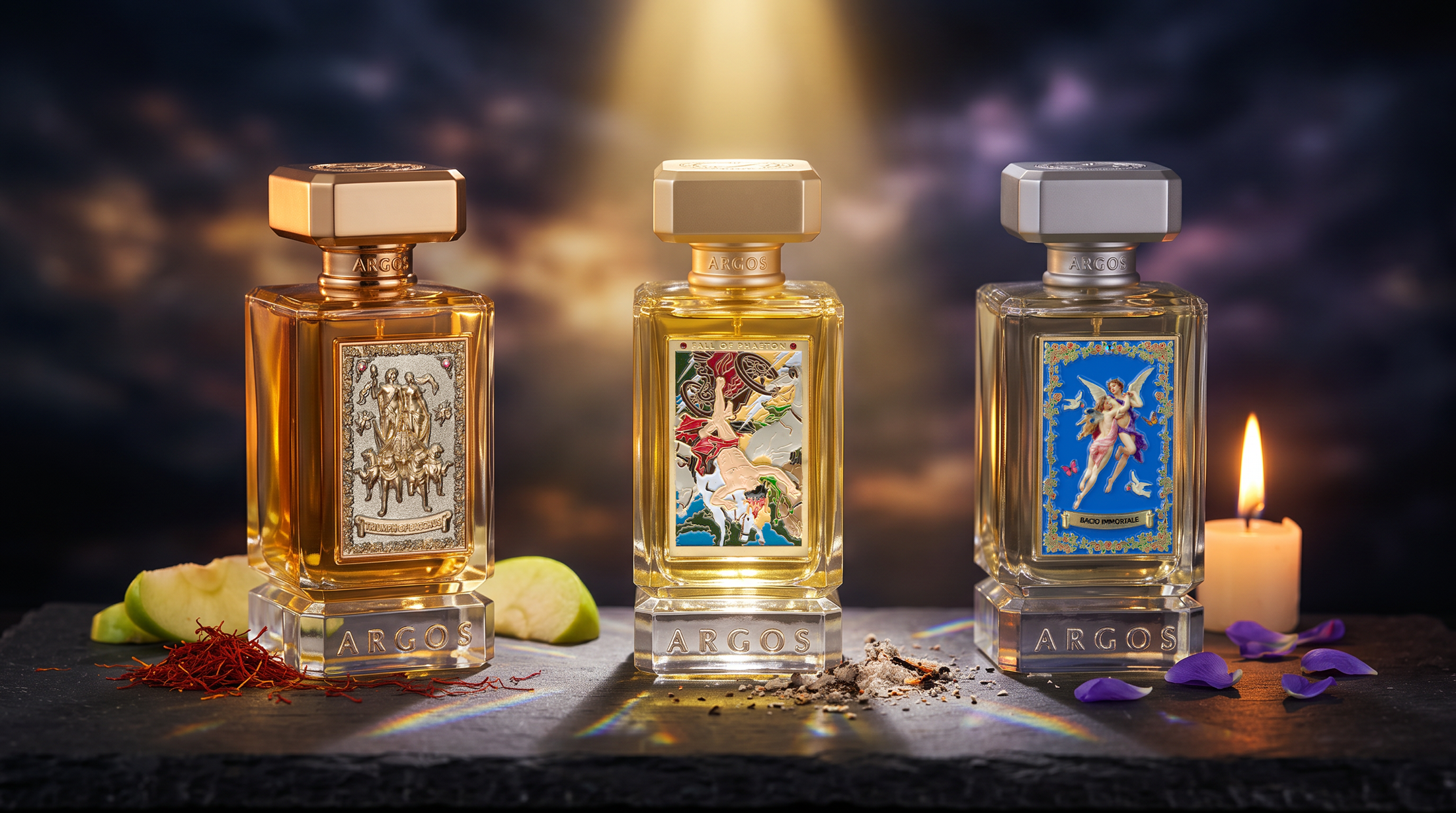
Triumph of Bacchus asks us to feel more. Fall of Phaeton challenges us to become more. Bacio Immortale reminds us what it means to love more. Together, they lead us into the beautiful and sometimes dangerous territory between wanting something and being willing to pursue it.

To Feel More
Triumph of Bacchus: The Art of Indulgence

Bacchus understood something modern life occasionally makes us forget: not every moment needs to be productive. Some deserve simply to be experienced.
The Roman god associated with wine, ecstasy, liberation, and celebration represented the temporary surrender of restraint: the permission to step outside the ordinary and experience life with greater intensity. There is a reason celebration has remained one of humanity's oldest rituals. We gather around tables. We open bottles saved for special occasions. We stay longer than intended because the conversation is too good to interrupt. And sometimes the evening becomes memorable precisely because, for a few hours, nobody is thinking about tomorrow.
Triumph of Bacchus captures that sense of abundance. Saffron, rhum notes, white peach, and green apple create an opening that feels immediately generous and inviting. Patchouli, jasmine, tonka bean, and vetiver deepen the composition before tobacco, amber, Mysore sandalwood, musk, and vanilla create its warm, seductive foundation.
Nothing about the composition feels apologetic. Nor should it. Because indulgence, at its most elegant, is not excess without meaning. It is the decision to recognize when a moment deserves more. More laughter. More conversation. One more glass. One more hour. One more memory worth carrying home.
Fragrance Notes: Saffron, Rhum Notes, White Peach, Green Apple / Patchouli, Jasmine, Tonka Bean, Vetiver / Tobacco, Amber, Mysore Sandalwood, Musk, Vanilla
Bacchus teaches us to surrender occasionally to experience. But another figure of mythology wanted something entirely different. He did not want pleasure. He wanted proof. And to obtain it, Phaeton reached for the sun.
To Become More
Fall of Phaeton: The Price of Daring

There is ambition. And then there is the desire to prove that the impossible was never impossible at all.
Phaeton wanted proof. In Greek mythology, Phaeton was the son of Helios, god of the sun. Determined to prove his divine parentage, he sought something no mortal could safely possess: control of his father's golden chariot, the vessel responsible for carrying the sun across the heavens. Helios warned him. The horses were too powerful. The path across the sky demanded precision. Even the gods understood the danger of commanding such extraordinary force. But Phaeton had already made his choice.
He took the reins. For one extraordinary moment, he possessed exactly what he had wanted. Then everything began to unravel. Unable to control the fiery horses, Phaeton veered from the celestial path. The earth was scorched in some places and frozen in others as the chariot descended into chaos. To restore order, Zeus intervened, striking Phaeton from the heavens. The boy who wanted to touch the sun fell from it instead.
It would be easy to remember Phaeton only for his failure. Yet that is not why his story has survived. Centuries later, Flemish Baroque master Peter Paul Rubens captured the chaos of the myth in The Fall of Phaeton. Bodies twist through the heavens. Horses recoil in terror. Light tears through darkness. The painting freezes the precise instant when extraordinary ambition collides with consequence. It is violent. Beautiful. Almost impossible to look away from.
That same tension lies at the heart of Fall of Phaeton by the House of Argos. Where Triumph of Bacchus invites surrender, Fall of Phaeton demands momentum.
Bergamot and lemon flash through the opening with electric brightness, while cardamom, pink peppercorn, and ginger create a rush of heat and spice. Then the composition darkens. Labdanum brings a smoldering, resinous warmth. Lavender cuts through the intensity with aromatic refinement, while agarwood adds depth and shadow. Finally, rich musk and leather emerge alongside tonka bean and vanilla, leaving behind a foundation that feels powerful, provocative, and unmistakably bold. The fragrance does not romanticize safety. Neither did Phaeton.
There is a reason stories about ambition continue to fascinate us. Nearly everyone has experienced the desire to discover what might happen if we pushed a little further. Applied for the position we were not certain we could get. Boarded the plane without knowing exactly what waited on the other side. Started the business. Took the risk. Entered the room before we felt completely ready.
Ambition always contains uncertainty. That does not make recklessness admirable, nor does Phaeton's tragedy suggest that every risk deserves to be taken. His myth has endured partly because it forces us to confront the boundary between courage and overreach. But perhaps it also reminds us of something else. A life spent avoiding every possibility of failure carries its own kind of risk. Phaeton reached too far. Yet he reached. And thousands of years later, we still remember his name.
Fragrance Notes: Bergamot, Lemon, Cardamom, Pink Peppercorn, Ginger / Labdanum, Lavender, Agarwood / Rich Musk, Leather, Tonka Bean, Vanilla
Bacchus teaches us what it means to feel more. Phaeton reveals the extraordinary and sometimes dangerous desire to become more. But mythology preserves another kind of desire. One that neither celebration nor ambition can fully explain. The desire to choose another person even when doing so demands everything from you. For Eros and Psyche, wanting more meant refusing to surrender their love. And their story would ultimately become immortal.
To Love More
Bacio Immortale: When Desire Becomes Devotion

Ambition asks how far we are willing to climb. Love asks an entirely different question: how much are we willing to endure?
Few myths answer that question more beautifully than the story of Eros and Psyche. Psyche was a mortal woman of such extraordinary beauty that she drew the attention and jealousy of Venus. What followed was not an effortless romance, but a love tested by doubt, separation, impossible trials, and a journey that carried Psyche even into the depths of Hades. Again and again, she was given reasons to surrender. She continued. Because unlike Phaeton, Psyche was not reaching for glory. She was reaching for someone.
Her devotion ultimately led her back to Eros, and Psyche was granted immortality, allowing their union to transcend the boundary between mortal and divine. It is from this enduring story that Bacio Immortale, meaning Immortal Kiss, draws its inspiration. If Triumph of Bacchus explores the desire to experience life fully, and Fall of Phaeton captures the dangerous pull of ambition, Bacio Immortale turns inward toward perhaps the most powerful desire of all: to find something worth choosing again and again.
The fragrance opens with bergamot and lemon, their brightness sharpened by pepper and softened by the sweetness of raspberry. The effect is immediate: radiant, intriguing, and just slightly provocative. Then the composition draws closer. Violet and jasmine introduce floral elegance while leather brings warmth and sensuality. Pink peppercorn adds another flicker of spice, creating a heart that balances tenderness with unmistakable intensity.
As the fragrance settles, its character deepens. Musk softens against the skin while leather returns with greater richness. Oud introduces smoky depth, birch adds a darker woody character, and vanilla brings warmth to the final impression. Light and shadow. Tenderness and desire. Softness and strength.
Perhaps that contrast is precisely what makes Bacio Immortale such a fitting interpretation of Eros and Psyche. Their love was not immortal because it was easy. It became immortal because it endured.
Fragrance Notes: Bergamot, Lemon, Pepper, Raspberry / Violet, Jasmine, Leather, Pink Peppercorn / Musk, Leather, Oud, Birch, Vanilla
The Beautiful Danger of Wanting More

Three legends. Three desires. And three very different answers to the same ancient question: what are you willing to risk for something extraordinary?
Bacchus reminds us to feel more, to recognize the moments when life asks us to stop measuring time and simply experience it. Phaeton challenges us to become more, to acknowledge the ambition that pushes us beyond what is familiar, while remembering that courage and consequence often travel together. Psyche teaches us to love more, to understand that the deepest forms of devotion are rarely defined by perfection, but by what remains when love has been tested.
Their stories have survived for centuries because the desires beneath them never disappeared. We still celebrate. We still reach. We still fall in love. And perhaps wanting more was never the danger. Perhaps the real question has always been what we choose to want more of. More experiences that become memories. More courage to pursue what once felt beyond reach. More connection with the people who make ordinary moments extraordinary.
Mythology gave those desires names and transformed them into legends. Fine fragrance gives them another language. Invisible, deeply personal, and inseparable from memory, fragrance allows a story to move beyond the page and become something we experience on the skin. To understand how ancient myths inspire every Argos composition is to understand why these three fragrances carry the weight they do.
Since 2014, the House of Argos has transformed the timeless worlds of mythology, fine art, and history into modern olfactory experiences. Through exceptional craftsmanship and artistic storytelling, ancient emotions — indulgence, ambition, devotion, triumph, temptation, and transformation — are reimagined in Extrait de Parfum for a new generation. Because perhaps the desire for something extraordinary has always been part of what makes us human.
The desire to feel deeply. To reach higher. To love without reservation. To leave the ordinary behind, if only for a moment. The ancient world had many names for such impulses. We call it passion.
Not sure which legend speaks to you? The Argos sample pack lets you experience all three on your own skin before choosing.
Written by Lucien Marlowe, Luxury Fragrance Editor, The House of Argos Journal
"Exploring the timeless intersection of mythology, fine art, and modern perfumery."
Inspired by Mythology. Crafted Through Art. Remembered Through Fragrance.
Frequently Asked Questions
What does Triumph of Bacchus smell like?
Triumph of Bacchus opens with saffron, rhum notes, white peach, and green apple, creating a warm and generous first impression. The heart develops through patchouli, jasmine, tonka bean, and vetiver. The base of tobacco, amber, Mysore sandalwood, musk, and vanilla delivers a rich, seductive, and enduring dry-down. It is a celebration fragrance built for occasions that deserve to be remembered.
What is Fall of Phaeton inspired by?
Fall of Phaeton draws from the Greek myth of Phaeton, son of Helios, who seized his father's sun chariot and was struck down by Zeus when the horses went out of control. The fragrance also references Peter Paul Rubens' Baroque painting of the same moment. It opens with bergamot, lemon, cardamom, pink peppercorn, and ginger, develops through labdanum, lavender, and agarwood, and settles into rich musk, leather, tonka bean, and vanilla. The character is bold, spiced, and atmospheric.
What is the myth behind Bacio Immortale?
Bacio Immortale, meaning Immortal Kiss, is inspired by the myth of Eros and Psyche from Greek mythology. Psyche, a mortal, endured separation, divine jealousy, and a descent into Hades to be reunited with Eros. Her devotion eventually earned her immortality. The fragrance opens with bergamot, lemon, pepper, and raspberry, develops through violet, jasmine, leather, and pink peppercorn, and settles into musk, oud, birch, and vanilla, capturing the tension between tenderness and desire.
What are the three desires represented by these fragrances?
Triumph of Bacchus represents the desire to feel more, the art of recognizing when a moment deserves full presence and celebration. Fall of Phaeton represents the desire to become more, the ambition to push beyond the familiar even at the risk of consequence. Bacio Immortale represents the desire to love more, the devotion that endures through trials and chooses to remain. Together they explore the beautiful and sometimes dangerous territory of wanting something extraordinary.
Which of the three fragrances is best for evening wear?
All three lean toward evening and occasion wear, but with different characters. Triumph of Bacchus is the warmest and most celebratory, ideal for dinners, events, and autumn or winter evenings. Fall of Phaeton is the boldest and most dramatic, suited to statement occasions and cooler-weather nights. Bacio Immortale is the most intimate of the three, with its leather-violet-oud profile sitting close to the skin and working beautifully for romantic evenings year-round.
Where can I buy these Argos fragrances?
Triumph of Bacchus Extrait de Parfum, Fall of Phaeton Eau de Parfum, and Bacio Immortale Eau de Parfum are all available at argosfragrances.com with fast US and international shipping. All Argos fragrances are cruelty-free and formulated without parabens, sulfates, phthalates, or mineral oil.

Leave a comment
This site is protected by hCaptcha and the hCaptcha Privacy Policy and Terms of Service apply.